On Interdisciplinarity: From Genesis to Convergence
Reflections on the evolution of knowledge, the division of disciplines, and modern synthesis
本文探讨知识的起源、分科的演化与当代跨学科研究的兴起。您可通过下方标签页在 中文 与 English 之间自由切换阅读。
This essay examines the genealogy of academic disciplines and the imperative of interdisciplinary synthesis. Toggle between the tabs below to read the original Chinese essay or the English version.
一、前言
1. 学科的滥觞——哲学
最早的学科,叫做哲学。
英语词语 philosophy 源于古希腊语中的 φιλοσοφία,意思为“爱智慧”,该词由 φίλος(philos,爱)和 σοφία(sophia,智慧)组合而成。为何?因为人自知无知,所以爱而追求智慧。哲学家叫做 philosopher,本意也就是爱智慧的人。苏格拉底正是有一句名言——I know that I know nothing。
🙂 For I was conscious that I knew practically nothing…
— Plato, Apology
当时还有一帮人,叫做诡辩士(sophist, σοφιστής)。我们现在知道诡辩是一个贬义词,而你看它的词源正是 σοφία,智慧。他们自以为掌握智慧,但实际上一无所知,只会用看似聪明但谬论式的欺骗性的论点进行推理,混淆视听。
🤪 The sophist is a trafficker in what seems to be, but is not, wisdom.
— Plato, Sophist
虽然哲学取得了极高的地位,但是诡辩士无处不在,直到如今也是如此,多少人自诩拥有智慧,实际上肚子里的知识甚是匮乏。
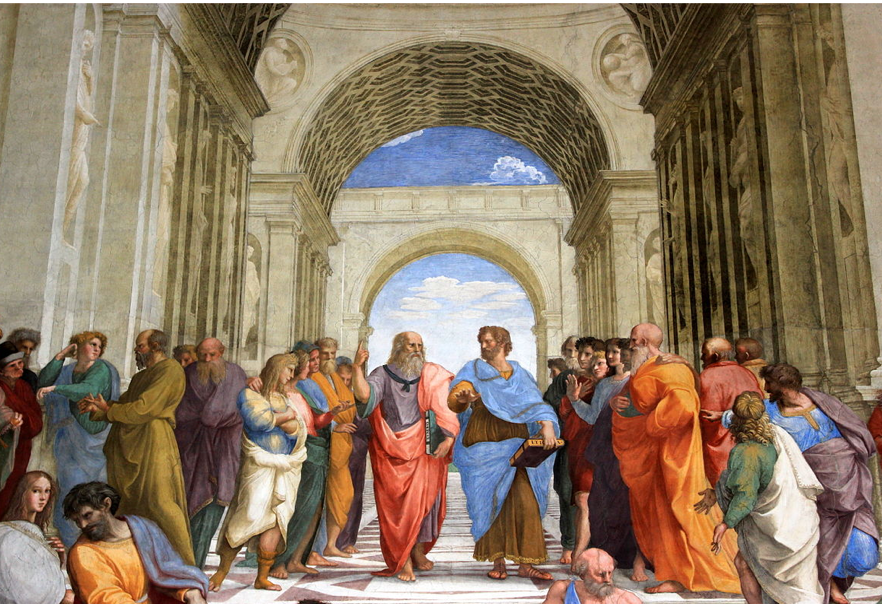
哲学家们好奇所有问题。你可以看到柏拉图在《理想国》(Republic)中讨论社会,在《会饮篇》(Symposium)中讨论美与爱;亚里士多德在《物理学》(Physics)中讨论物理,在《动物志》(History of Animals)中讨论动物分类。虽然他们的很多观点现在被证明为错误,但不可否认的是,他们为后续的所有学科奠定了基础框架。
2. 学科的分家——三足鼎立
\[\text{Humanities} \quad \longleftrightarrow \quad \text{Social Science} \quad \longleftrightarrow \quad \text{Natural Science}\]
哲学家们探讨着各类问题,但当时对学科的分类还不成体系,直到后世我们对这些学科完成系统性的整理归类。典型的分类方式是按照研究对象和研究方法综合划分,比如从 humanities 到 social science 到 natural science,研究对象是从人到物,方法从定性到定量:
- 人文学科:研究人,主要采用定性的方法;侧重挖掘人的复杂性。
- 社会科学:研究社会,定性和定量方法皆有。
- 自然科学:用定量的方法研究物;想要找到普世的规律。1
其中值得一提的是 Natural Science 的发展史。最早称作 Natural History,主要是观察各类生物,而现在就存有非常多的自然史博物馆;随后称作 Natural Philosophy,比如牛顿力学的著作就叫做《自然哲学的数学原理》(Philosophiae Naturalis Principia Mathematica, 1687);经过牛顿等科学家的实验探索与康德等哲学家对推理、逻辑等问题的研究,Natural Science 由此诞生。与 Natural Science 关系密切的还有 Applied Science,以科学原理去解决工程问题,以及 Formal Science,即数学这类非常抽象的学科,我们姑且把他们放在一类。

学科分家有很多原因,如上所述是研究对象和方法不一样。我们可以再举一些更靠近现在的例子,比如说哲学在 20 世纪就有英美的分析哲学和德法的欧陆哲学的对立,前者探讨语言和逻辑,后者研究权力、存在等问题。
学科分家也有很多时候是出于世俗的考量,比如自立门户,彰显自身的新学派等等。所以很多学科无限细分,导致彼此产生对立。比如说社科领域在 20 世纪出现的新专业——传播学和文化研究等,其实很多基础理论都是借鉴自社会学,只不过有一些新的噱头,前者是媒介,后者是大众文化。理工科领域则有数据科学,其实只是继承自数学中的统计学以及计算机中的机器学习等算法而已。
3. 学科的交叉——跨学科
🫡 The disciplines are the place where we begin, but not where we end.
学科虽已分家,但世界本身并没有分门别类地存在。复杂问题的解决往往要求我们跨越边界,在不同学科之间穿梭。因此,在“学科分家”之后,就是“学科交叉”的兴起。尤其是在 20 世纪后半叶以来,面对诸如生命本质、人工智能、全球气候等问题,传统单一学科已经显得捉襟见肘,越来越多的研究者开始尝试整合多个学科的视角与方法,催生了所谓的“跨学科”研究。
经典案例 1:DNA 双螺旋结构的发现
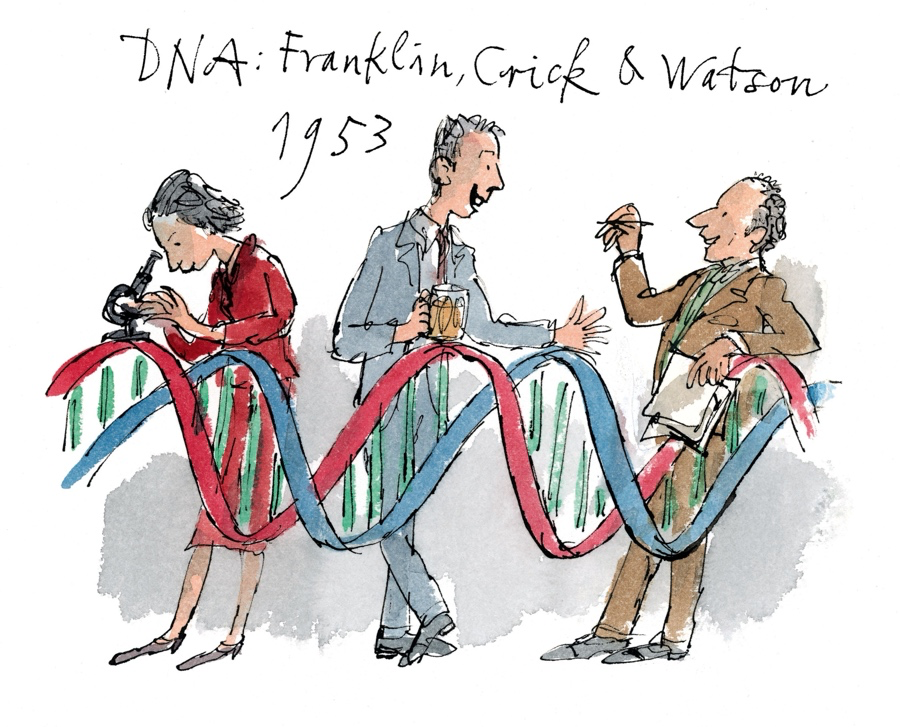
1953 年,詹姆斯·沃森(James Watson)和弗朗西斯·克里克(Francis Crick)共同发表了震动世界的论文2,揭示了 DNA 的结构模型。
这项成果的取得,正是跨学科合作的典范: - 沃森是生物学专业出身; - 克里克则是物理学博士。
两人所依赖的关键证据之一,是罗莎琳德·富兰克林(Rosalind Franklin)拍摄的 X 光晶体衍射图像——这是典型的物理方法;而他们推理出碱基对互补的配对方式,则融合了化学键合规律与分子建模技术。可以说,这项重大发现是物理学、生物学与化学交汇的产物。
经典案例 2:计算社会科学(Computational Social Science)与小世界网络
同样的跨界融合,也正在悄然改变人文与社会科学的研究范式。一个典型的例子是计算社会科学的兴起。传统社会科学擅长定性分析,比如通过访谈、田野调查来理解社会结构与人类行为;而今天,我们拥有了前所未有的数据规模和计算能力,使得我们可以用类似自然科学的方法来研究社会现象。
Duncan J. Watts 是这一领域的重要代表人物。他最初是物理学博士,却投身社会网络的研究。他受到“六度分隔”理论的启发——这个理论认为,任意两个人之间只隔着不超过六个人。听上去像是茶余饭后的游戏,但 Watts 意识到其中隐藏着复杂系统的深层规律。
于是他借用物理学中的网络模型与数学工具,构建出了著名的小世界网络(small-world networks)模型3:在一个高度聚集的网络中,随机重连部分边,整个系统的平均路径长度4就会迅速下降,世界也就因此变“小”了,同时这些节点也保持比较高的集聚程度。
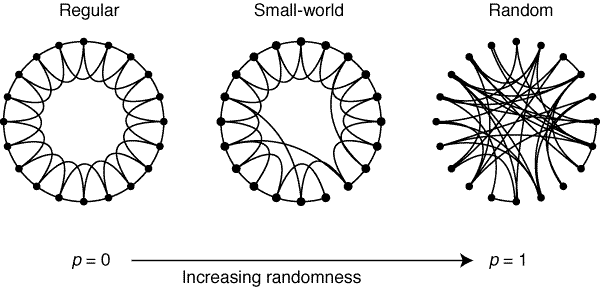
这个模型不仅解释了信息如何在社交网络中快速传播,也适用于理解疫情的扩散路径、电网的连通性,甚至神经元之间的连接方式。原本看似属于社会学的问题——比如人际关系、传播机制——如今通过数学建模和模拟实验获得了更具预测力的解释。这不仅是方法上的革新,更是思想路径上的交叉:一位物理学者,用自然科学方法,为社会科学提供了新的语言与工具。
结语:回归整体智慧
这样的例子不胜枚举: - 数字人文:人文学者开始使用文本挖掘算法来研究古典文献; - 行为经济学:经济学家与心理学家共同开发行为决策模型; - 空间历史学:历史学研究在使用地理信息系统(GIS)重建古代贸易路线……
这些都显示出,跨学科不仅是一种研究策略,更是一种回归整体智慧的姿态。
学科交叉并非否定分科的价值,而是在分科奠定的精深基础之上,搭建沟通的桥梁。它提醒我们,知识本为一体:“分家”是为了更深入地耕耘,而“交叉”则是为了更全面地收获。在人类探索未知的永恒征程中,学科的界限终将是流动的,唯有对智慧的不懈追求恒久不变——这,或许正是对古希腊“爱智慧”(φιλοσοφία)精神在当代最有力的呼应。
Preface
1. The Genesis: Philosophy as the Cradle of Inquiry
The earliest of all disciplines was philosophy.
The English word philosophy stems from the Ancient Greek φιλοσοφία (philosophia), literally translating to “the love of wisdom.” It joins φίλος (philos, loving/fond) and σοφία (sophia, wisdom). Why “love”? Because human beings recognize their own profound ignorance, and out of that humility arises the passionate pursuit of understanding. A philosopher (philosophos) is fundamentally a lover of wisdom. As Socrates famously professed:
🙂 For I was conscious that I knew practically nothing…
— Plato, Apology
Alongside the philosophers was another faction: the sophists (σοφistής). While “sophistry” today carries pejorative connotations of deceptive or hollow rhetoric, its etymological root is the very same sophia. The sophists boasted of possessing wisdom, yet had little of substance—relying instead on fallacious, superficially clever arguments to sway crowds and obfuscate truth.
🤪 The sophist is a trafficker in what seems to be, but is not, wisdom.
— Plato, Sophist
Though philosophy attained towering historical stature, sophists have remained ubiquitous. Even in our contemporary world, countless individuals posture as possessors of wisdom while their intellectual reservoir remains conspicuously shallow.
The classical philosophers possessed insatiable curiosity across every dimension of existence. Plato deliberated societal governance and justice in the Republic, and examined the aesthetics of love in the Symposium; Aristotle laid down foundational physics in Physics, and pioneered taxonomic classification in the History of Animals. While many of their empirical hypotheses have since been superseded, their inquiries established the enduring conceptual scaffolding for all subsequent fields of study.
2. The Great Bifurcation: A Tripartite Landscape
\[\text{Humanities} \quad \longleftrightarrow \quad \text{Social Science} \quad \longleftrightarrow \quad \text{Natural Science}\]
While antiquity treated knowledge as an interconnected web, later eras sought systematic classification. The canonical taxonomy balances the object of study against the method of inquiry: traversing from the humanities to social sciences to natural sciences, the focus shifts from humanity to the material universe, while methodologies transition from qualitative exploration to quantitative measurement:
- Humanities: Investigates human culture, literature, and inner experiences; predominantly qualitative, emphasizing nuance, meaning, and human complexity.
- Social Sciences: Interrogates human societies, institutions, and collective behavior; synthesizes both qualitative and quantitative approaches.
- Natural Sciences: Examines the physical cosmos through rigorous quantitative measurement, striving to reveal universal, invariant laws.1
The historical trajectory of Natural Science is particularly illuminating. It began as Natural History—largely observational cataloging of the living world (a heritage preserved in natural history museums). It evolved into Natural Philosophy, as immortalized in Sir Isaac Newton’s Philosophiae Naturalis Principia Mathematica (1687). Through the experimental paradigms of Newton and the epistemological critiques of Kant regarding reason and logic, modern Natural Science was crystallized. Closely affiliated are Applied Science (applying scientific principles to engineering solutions) and Formal Science (abstract symbolic domains such as mathematics and logic).
Disciplinary divergence occurs for genuine epistemic reasons—distinct questions require tailored tools. In 20th-century philosophy, for example, a sharp division arose between Anglo-American Analytic Philosophy (focusing on formal logic, semantics, and language) and Franco-German Continental Philosophy (grappling with phenomenology, existentialism, and sociopolitical power).
Yet specialization is also frequently spurred by institutional and pragmatic motives: academic turf-building, tenure systems, and the imperative to stake out novelty. In the 20th century, emerging fields like Communication Studies and Cultural Studies borrowed foundational theories from sociology while asserting distinct brand identities centered around media and popular culture. In STEM, the rise of Data Science represents a synthesis of classical mathematical statistics and computational machine learning algorithms.
3. The Convergence: Interdisciplinary Synthesis
🫡 The disciplines are the place where we begin, but not where we end.
Disciplines are institutional conventions, but reality itself has no borders. Resolving multifaceted global challenges compels us to cross disciplinary boundaries and think across silos. Thus, following centuries of fragmentation, the late 20th century witnessed a powerful counter-movement: the rise of interdisciplinarity. Confronted with questions as intricate as the molecular origin of life, cognitive artificial intelligence, and global climate systems, isolated single disciplines proved inadequate.
Case Study 1: The Discovery of the DNA Double Helix
In 1953, James Watson and Francis Crick published their landmark paper in Nature2, uncovering the double helix structure of DNA.
This monumental milestone stands as a classic paradigm of interdisciplinary collaboration: - James Watson was trained as a zoologist and geneticist. - Francis Crick was an applied physicist.
Their breakthrough rested upon the crucial X-ray diffraction patterns produced by Rosalind Franklin—an quintessentially physical technique. Meanwhile, resolving the complementary base pairing required integrating the chemical stereochemistry of hydrogen bonds with physical molecular modeling. The double helix was the joint triumph of physics, biology, and chemistry.
Case Study 2: Computational Social Science & Small-World Networks
This convergence is equally transforming the humanities and social sciences through the rise of Computational Social Science. Where traditional sociology relied primarily on qualitative interviews and ethnography, today’s researchers possess vast computational infrastructure and petabyte-scale data, allowing them to examine social phenomena with empirical methods borrowed from the natural sciences.
Duncan J. Watts is a seminal pioneer of this movement. Holding a PhD in physics, Watts directed his mathematical training toward social networks. Intrigued by the popular “six degrees of separation” concept, Watts recognized that beneath this colloquial curiosity lay profound mathematical principles of complex systems.
Together with Steven Strogatz, Watts formulated the renowned Small-World Networks Model3: by taking a highly clustered regular network and randomly rewiring a small fraction of edges, the system’s average path length4 drops precipitously. The world shrinks into a “small world,” while maintaining high local clustering.
This model illuminates not only information diffusion on social media, but also epidemiological vector spread, power grid vulnerabilities, and neural synaptogenesis. Questions once confined to descriptive sociology—interpersonal dynamics, social contagion—have attained predictive, mathematical clarity. It marks both a methodological evolution and an epistemological cross-pollination: a physicist using the language of natural science to supply social scientists with transformative tools.
Conclusion: A Return to Holistic Wisdom
Illustrations of this convergence multiply across the academy: - Digital Humanities: Scholars applying text-mining and natural language processing to classical corpora; - Behavioral Economics: Economists partnering with cognitive psychologists to model human decision bias; - Spatial History: Historians leveraging Geographic Information Systems (GIS) to reconstruct ancient trade routes.
These trends remind us that interdisciplinarity is not merely a fashionable research methodology—it is an intellectual posture that honors the unity of knowledge.
Interdisciplinary convergence does not invalidate specialization; rather, it constructs bridges atop the profound foundations laid by individual disciplines. It reaffirms that knowledge is fundamentally one: we divide our inquiry to cultivate the depths, and we connect our insights to reap a holistic harvest. In humanity’s enduring quest into the unknown, academic boundaries will remain fluid. What remains eternal is our boundless pursuit of understanding—the purest contemporary resonance with the ancient Greek ideal of philosophia (φιλοσοφία), the love of wisdom.
Footnotes
-
Kagan, J. (2009). The three cultures: Natural sciences, social sciences, and the humanities in the 21st century. Cambridge University Press.
-
Watson, J. D., & Crick, F. H. (1953). Molecular structure of nucleic acids: a structure for deoxyribose nucleic acid. Nature, 171(4356), 737–738.
-
Watts, D. J., & Strogatz, S. H. (1998). Collective dynamics of ‘small-world’ networks. Nature, 393(6684), 440–442.
-
平均路径长度 (Average Path Length):网络中任意两个节点之间的平均最短路径长度 / The average shortest distance between any two arbitrary nodes in the network.